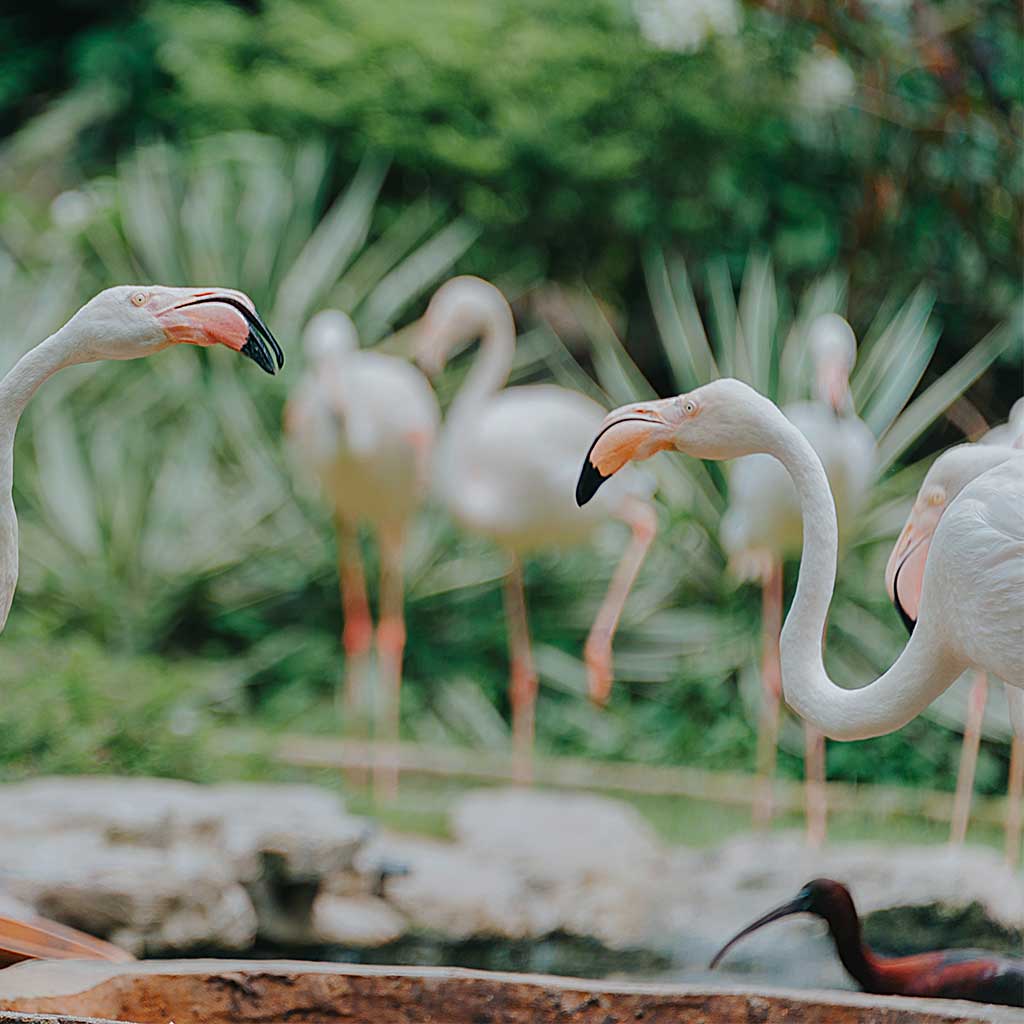
How Many Flamingo Species Are There?
There are six recognized living flamingo species. They occur naturally in parts of Africa, Europe, Asia, the Caribbean, and South America. The American flamingo also occurs in the Galápagos, Mexico, and occasionally Florida.
All six belong to the family Phoenicopteridae, but they are not simply different-sized versions of the same bird. Their ranges, feeding adaptations, plumage, leg colors, and conservation needs differ.
What all flamingos have in common
Flamingos have long legs, webbed feet, flexible necks, and bills adapted for filter feeding. They feed with their heads inverted, using a muscular tongue to pump water through rows of comb-like plates called lamellae. The lamellae trap food such as algae, diatoms, tiny crustaceans, insect larvae, mollusks, and other small aquatic organisms. The mix and size of food varies by species and habitat.
Pink plumage comes from carotenoid pigments obtained through the food chain. Chicks hatch with pale down, and immature birds are normally gray, white, or brownish before gradually acquiring adult plumage. A young flamingo is not gray merely because it has failed to eat enough colorful food.
Size also varies considerably. The greater flamingo is the largest species, while the lesser flamingo is the smallest. Flamingos can live for decades, especially under managed care, but lifespan varies among individuals and species.
The six living flamingo species
1. American flamingo (Phoenicopterus ruber)
Also called the Caribbean flamingo, this is usually the most intensely colored species. Adults can be deep coral, pink, or reddish-orange, with black flight feathers visible when the wings open.
American flamingos live mainly around the Caribbean and adjacent regions, including Cuba, the Bahamas, the Yucatán Peninsula, coastal northern South America, and the Galápagos Islands. Historical evidence and modern sightings support the American flamingo as native to Florida, although it is not common there.
Typical habitats include shallow saline lagoons, mudflats, salt pans, and coastal wetlands.
Global IUCN Red List category, checked 4 July 2026: Least Concern.
2. Greater flamingo (Phoenicopterus roseus)
The greater flamingo is the largest flamingo species. Its plumage is generally pale pink or pinkish white rather than bright red. The wing coverts can be stronger pink or red, while the flight feathers are black.
Its wide range includes parts of Africa, southern Europe, the Middle East, and South and Southwest Asia. Some populations migrate or make irregular movements as water levels, food, weather, and breeding conditions change. Their routes cannot be reduced to every Asian bird moving to Iran or India in winter.
Greater flamingos use saline and alkaline lakes, coastal lagoons, estuaries, salt pans, and other shallow wetlands. Their diet varies locally and can include small crustaceans, mollusks, insect larvae, algae, diatoms, and other aquatic organisms.
Global IUCN Red List category, checked 4 July 2026: Least Concern.
3. Lesser flamingo (Phoeniconaias minor)
The lesser flamingo is the smallest species, generally standing about 80–90 centimeters tall. It occurs mainly in sub-Saharan Africa, with additional populations in India and nearby parts of South Asia.
It is adapted to filter very small food particles. Its densely packed lamellae help it collect microscopic cyanobacteria and algae from alkaline and saline waters. Adults usually have pink plumage, red eyes, and a dark red bill that can look almost black from a distance.
Unlike the Andean and Puna flamingos, the lesser flamingo retains a small hind toe, or hallux.
Global IUCN Red List category, checked 4 July 2026: Near Threatened.
4. Puna flamingo (Phoenicoparrus jamesi)
The Puna flamingo is also called James’s flamingo. It belongs to the same genus as the Andean flamingo and is one of three flamingo species native to South America.
It inhabits high Andean salt lakes and lagoons, mainly in Bolivia, Chile, Argentina, and Peru. Birds may move to lower wetlands in winter or when high-altitude conditions become unfavorable.
The Puna flamingo is smaller than the Andean flamingo. It has pale pink plumage, brighter pink or red feathers across the back, reddish legs, and a yellow bill with a black tip. Like the Andean flamingo, it has three forward toes and no hind toe. Its fine filtering structures are suited to a diet dominated by tiny algae and diatoms.
Global IUCN Red List category, checked 4 July 2026: Near Threatened.
5. Andean flamingo (Phoenicoparrus andinus)
The Andean flamingo is the largest of the three South American species and the most globally threatened of the world’s six flamingo species. It inhabits high-altitude saline wetlands from southern Peru through western Bolivia and northern Chile to northwestern Argentina.
Adults have pale pink plumage, yellow legs, and a bill that is pale yellow near the base and mostly black toward the tip. The black flight feathers form a conspicuous dark area at the rear when the wings are folded.
Andean flamingos filter small food particles, particularly diatoms and other microscopic organisms. They do not specialize in catching large “sea creatures”; their principal habitats are inland high-Andean lakes and wetlands. Like the Puna flamingo, they lack a hind toe.
Global IUCN Red List category, checked 4 July 2026: Vulnerable. Important threats include disturbance and the loss or degradation of high-Andean wetlands.
6. Chilean flamingo (Phoenicopterus chilensis)
The Chilean flamingo occurs from Peru and southern Brazil south through Bolivia, Uruguay, Chile, and Argentina. It uses saline lakes, high-altitude wetlands, estuaries, coastal mudflats, and lagoons.
These habitats are not all warm or tropical. Chilean flamingos also live in cool, temperate, and high-elevation environments.
Adults have pale pink plumage, grayish legs with conspicuous pink joints, and a bill that is pale near the base and mostly black toward the tip. Unlike the Andean and Puna flamingos, this species has a small hind toe.
Global IUCN Red List category, checked 4 July 2026: Near Threatened.
A quick comparison
| Species | Main natural range | Useful identification feature | Global IUCN category checked 4 July 2026 |
|---|---|---|---|
| American flamingo | Caribbean, adjacent Americas, Galápagos | Deep coral or reddish-pink plumage | Least Concern |
| Greater flamingo | Africa, southern Europe, Middle East, South and Southwest Asia | Largest species; generally pale plumage | Least Concern |
| Lesser flamingo | Sub-Saharan Africa and parts of South Asia | Smallest species; very dark bill | Near Threatened |
| Puna flamingo | High Andes | Yellow-and-black bill; no hind toe | Near Threatened |
| Andean flamingo | High Andes | Yellow legs; extensive black on bill; no hind toe | Vulnerable |
| Chilean flamingo | Southern South America | Gray legs with bright pink joints | Near Threatened |
Conservation categories can change after reassessment. Check the current IUCN Red List or BirdLife DataZone before using these categories for research, conservation planning, or policy.
Sources
- AviList 2025b: current global avian taxonomy
- IUCN SSC Flamingo Specialist Group: species descriptions
- BirdLife International: flamingo conservation overview
- Animal Diversity Web: flamingo family, anatomy, and feeding
- Ardila and Posso: anatomy of the Chilean flamingo feeding apparatus
- Animal Diversity Web: American flamingo
- Animal Diversity Web: lesser flamingo
- Animal Diversity Web: Puna flamingo
- Animal Diversity Web: Andean flamingo
- Animal Diversity Web: Chilean flamingo
- IUCN: Andean flamingo conservation profile
Scientific and conservation information reviewed 4 July 2026.